Graphical perception

Lecture 24

Dr. Mine Çetinkaya-Rundel

Duke University
STA 313 - Spring 2026

Warm up

Setup

# load packages
library(tidyverse)

# set theme for ggplot2
ggplot2::theme_set(ggplot2::theme_minimal(base_size = 16))

# set figure parameters for knitr
knitr::opts_chunk$set(
  fig.width = 7, # 7" width
  fig.asp = 0.618, # the golden ratio
  fig.retina = 3, # dpi multiplier for displaying HTML output on retina
  fig.align = "center", # center align figures
  dpi = 300 # higher dpi, sharper image
)

A foundational paper

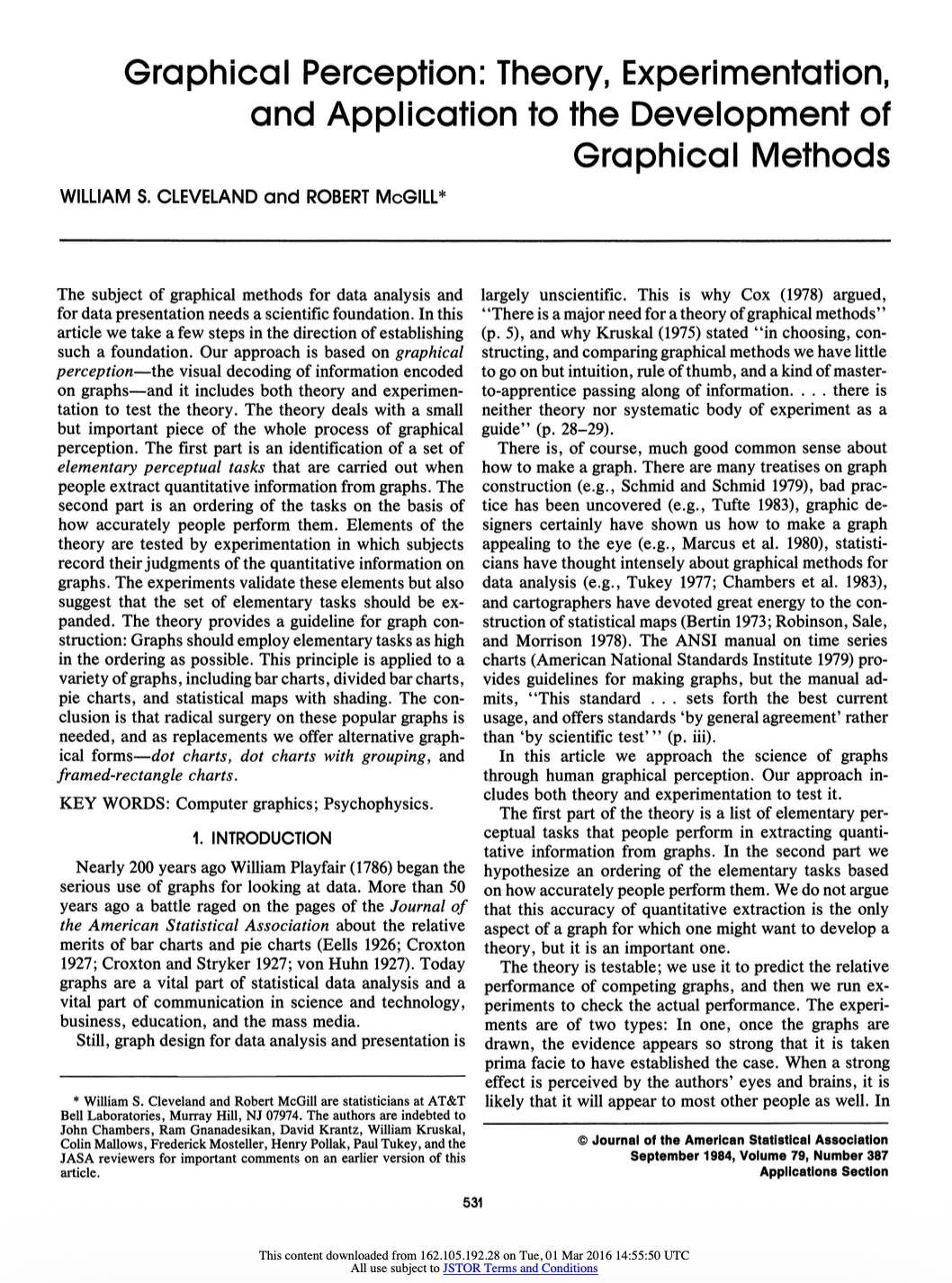
Cleveland & McGill (1984)

“Graphical Perception: Theory, Experimentation, and Application to the Development of Graphical Methods”

Journal of the American Statistical Association

  • William S. Cleveland and Robert McGill (AT&T Bell Labs)
  • One of the most influential papers in data visualization
  • Established empirical foundations for graph design
  • Over 2,800 citations

The central question

What makes some graphs easier to read than others?

Cleveland & McGill’s approach:

  1. Identify elementary perceptual tasks used when reading graphs
  2. Rank these tasks by accuracy of human judgment
  3. Test the ranking experimentally
  4. Apply findings to redesign common graph types

What is graphical perception?

Graphical perception is the visual decoding of information encoded on graphs, i.e., the mental-visual tasks we perform to extract quantitative information:

  • Judging positions along a scale
  • Comparing lengths
  • Estimating angles
  • Perceiving areas
  • Distinguishing colors/shades

Elementary perceptual tasks

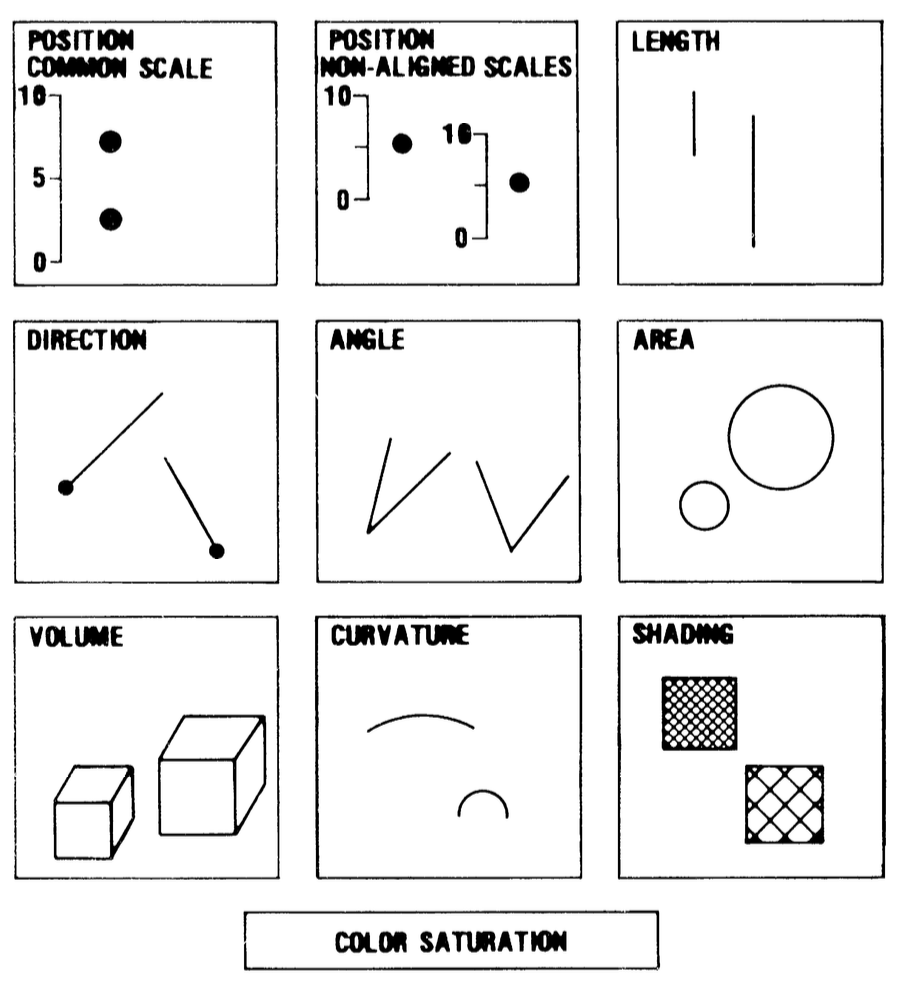
10 Elementary perceptual tasks

Cleveland & McGill identified 10 basic visual tasks people use to extract quantitative information from graphs:
The accuracy hierarchy

Cleveland & McGill hypothesized a ranking from most accurate to least accurate:

Rank Elementary Perceptual Task
1 Position along a common scale
2 Position along non-aligned scales
3 Length, direction, angle
4 Area
5 Volume, curvature
6 Shading, color saturation

Important

Design principle: Use elementary perceptual tasks as high in the hierarchy as possible.

Why this ordering?

The ordering is based on:

  • Psychophysical theories:

    • Stevens’ Power Law
    • Weber’s Law
  • Prior experimental research on magnitude estimation

Stevens’ Power Law

Perceived magnitude \(p\) relates to actual magnitude \(a\) by:

\[p = k \cdot a^\alpha\]

  • For length: \(\alpha \approx 1\) (accurate)

  • For area: \(\alpha < 1\) (underestimate)

  • For volume: \(\alpha << 1\) (severely underestimate)

Get ready to answer some questions!

https://app.wooclap.com/STA313S26

Question 1

Which of the following is true?

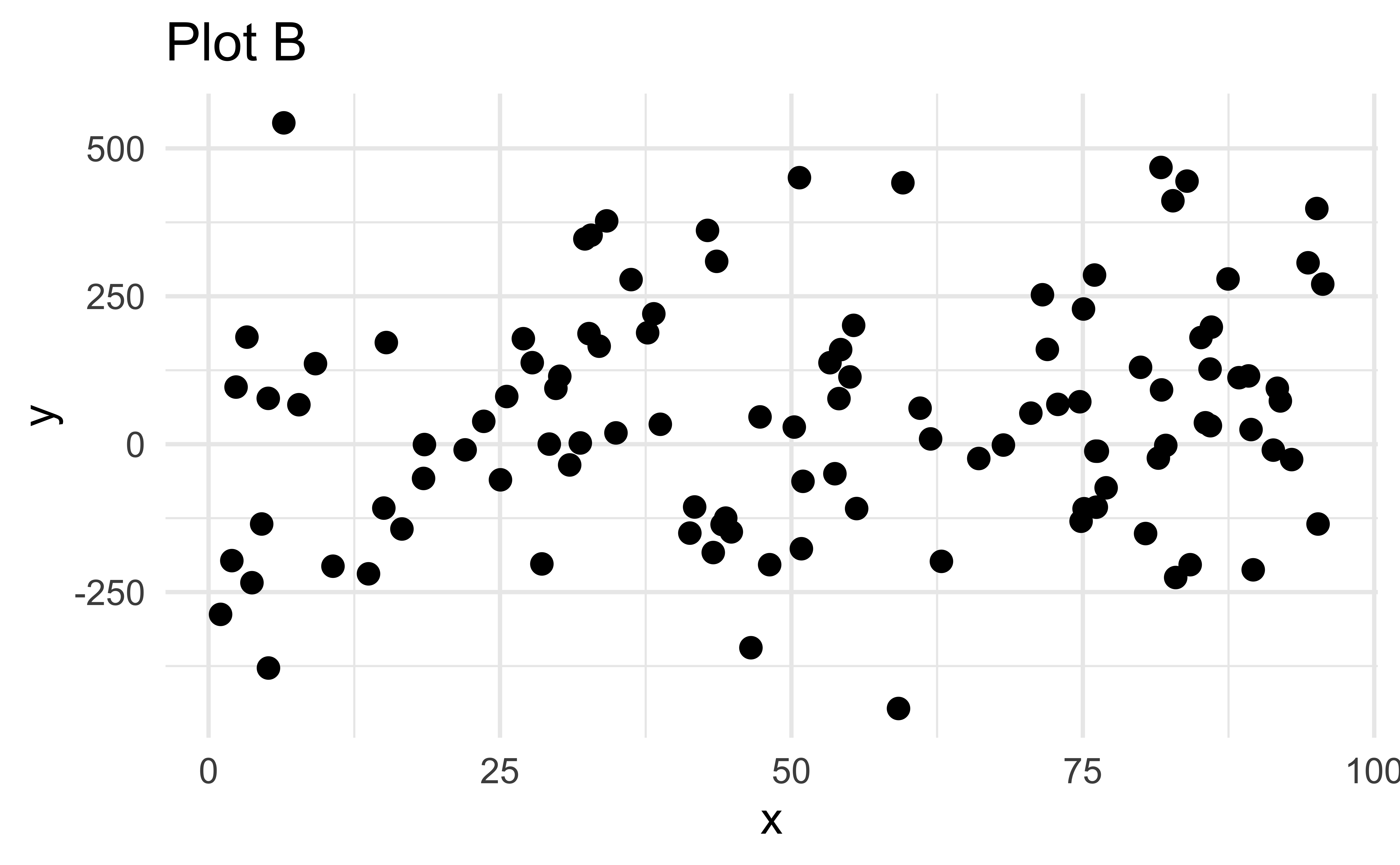
  1. Plot A has more points than Plot B
  2. Plot B has more points than Plot A
  3. Plot A and Plot B have the same number of points

Question 2

Which of the following is true?

  1. Plot A has more points than Plot B
  2. Plot B has more points than Plot A
  3. Plot A and Plot B have the same number of points
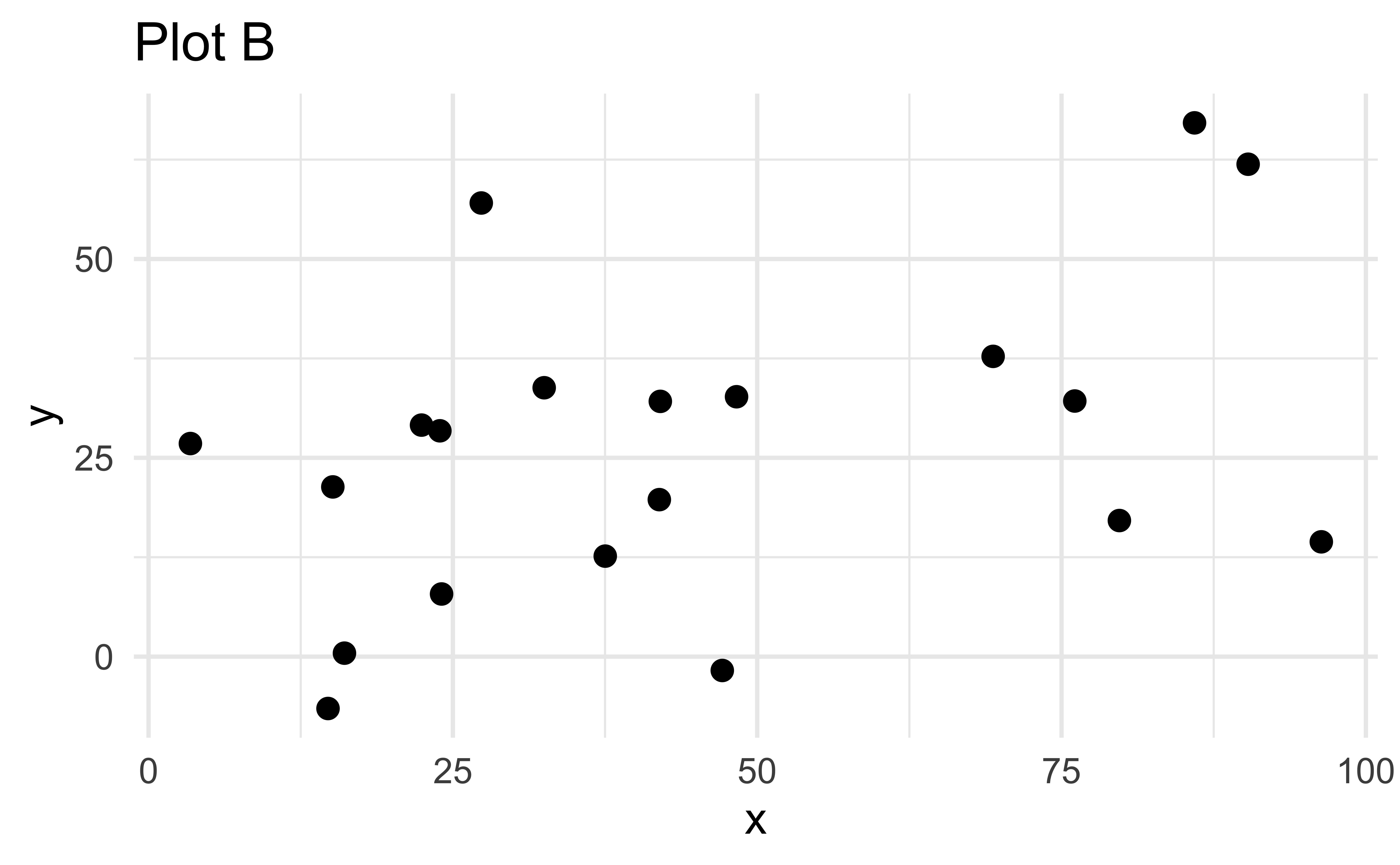
Question 1

set.seed(123)

n1 <- 10
x <- runif(n1, 1, 100)
y <- 0.5 * x + rnorm(n1, mean = 0, sd = 20)
df <- tibble(x = x, y = y)
ggplot(df, aes(x = x, y = y)) +
  geom_point(size = 3) +
  labs(title = "Plot A")
n2 <- 20
x <- runif(n2, 1, 100)
y <- 0.5 * x + rnorm(n2, mean = 0, sd = 20)
df <- tibble(x = x, y = y)
ggplot(df, aes(x = x, y = y)) +
  geom_point(size = 3) +
  labs(title = "Plot B")

Question 2

set.seed(456)

n3 <- 120
x <- runif(n3, 1, 100)
y <- 0.5 * x + rnorm(n3, mean = 0, sd = 200)
df <- tibble(x = x, y = y)
ggplot(df, aes(x = x, y = y)) +
  geom_point(size = 3) +
  labs(title = "Plot A")
n4 <- 110
x <- runif(n4, 1, 100)
y <- 0.5 * x + rnorm(n4, mean = 0, sd = 200)
df <- tibble(x = x, y = y)
ggplot(df, aes(x = x, y = y)) +
  geom_point(size = 3) +
  labs(title = "Plot B")

Weber’s Law

Just noticeable difference is proportional to the magnitude of the initial stimulus.

The minimum increase of stimulus which will produce a perceptible increase of sensation is proportional to the pre-existent stimulus.

Common graphs and their tasks

Graph Type Primary Perceptual Task
Bar chart (simple) Position on common scale
Grouped bar chart Position on common scale
Stacked bar chart Length (for non-baseline segments)
Pie chart Angle
Bubble chart Area
Choropleth map Shading/color
Treemap Area

Example: Bar chart vs. Pie chart

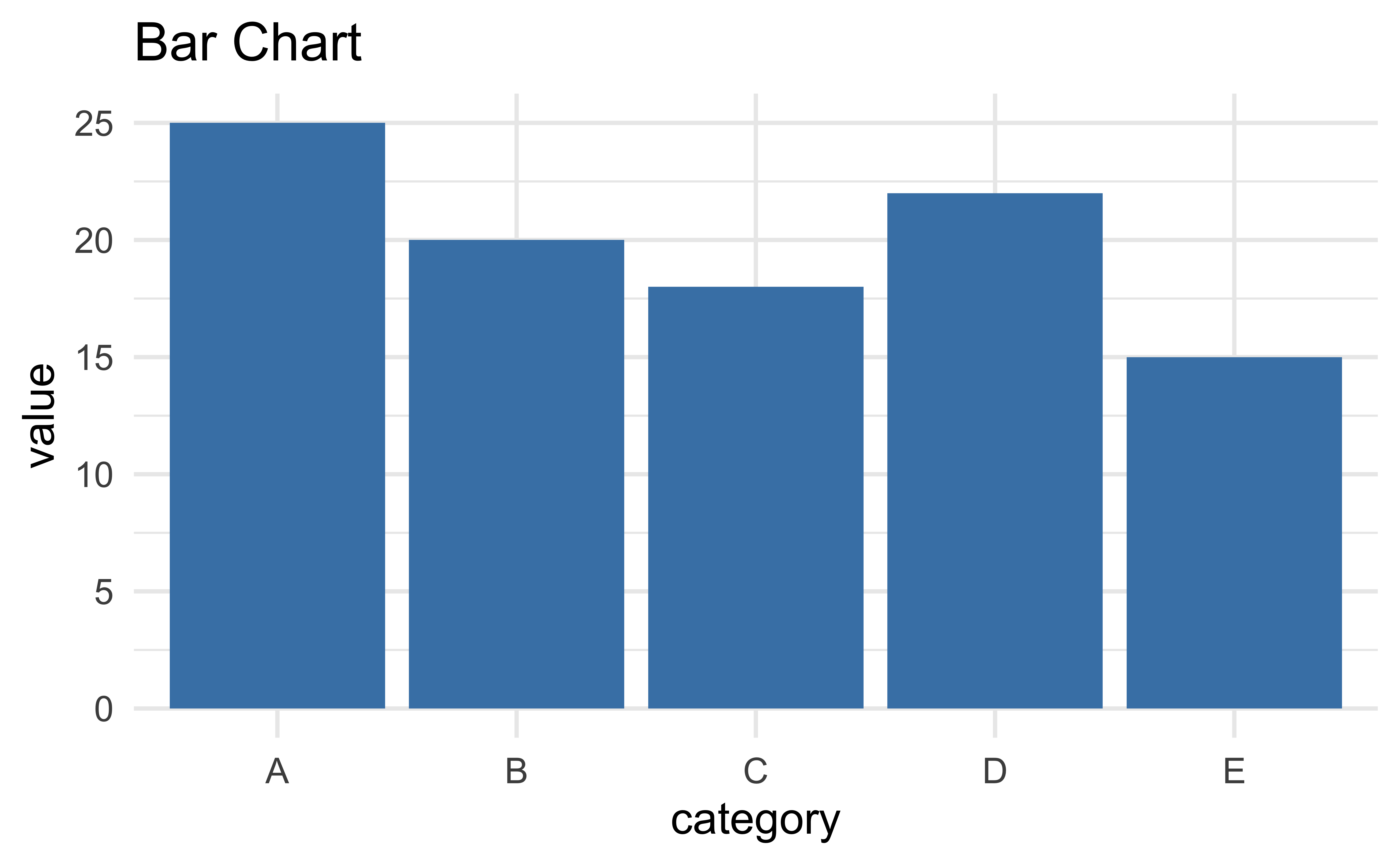
Bar chart

  • Primary task: Position along common scale
  • High accuracy
  • Easy to compare values

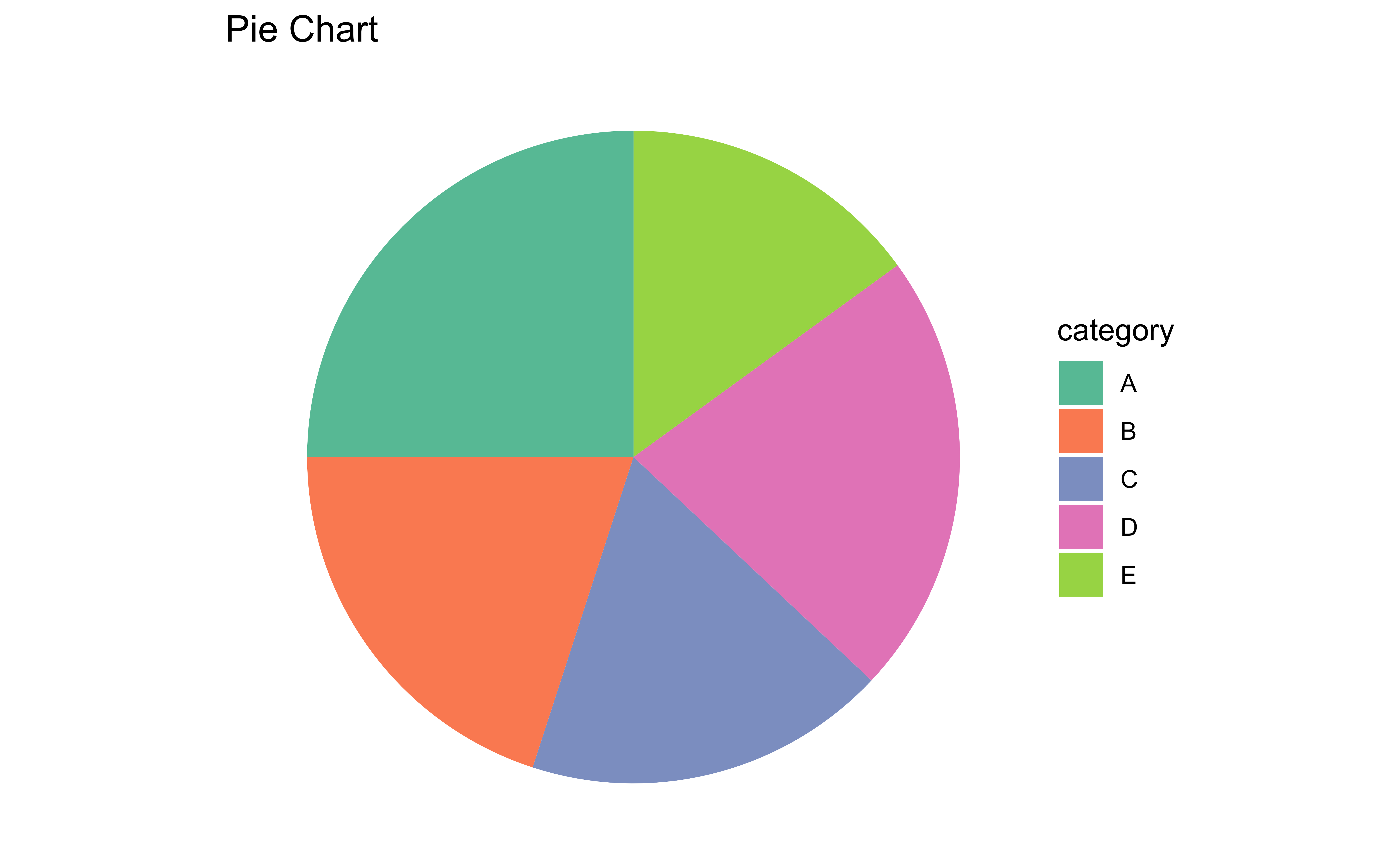
Pie chart

  • Primary task: Angle judgment
  • Lower accuracy
  • Harder to compare non-adjacent slices

The experiments

Experimental design

Cleveland & McGill ran two main experiments.

  • Experiment 1: Position-length judgments using bar charts

  • Experiment 2: Position-angle judgments comparing bar charts and pie charts

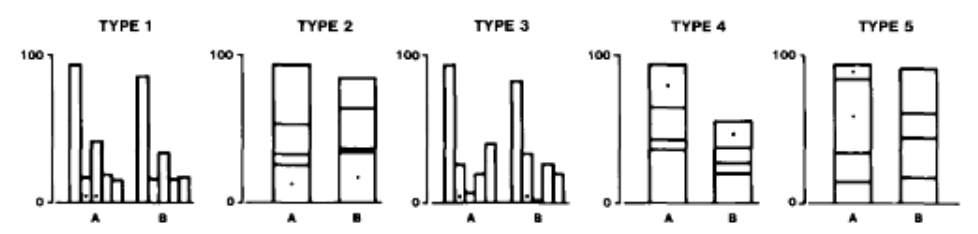
Experiment 1: Position-length

  • 55 subjects judged divided bar charts
  • 5 types of bar chart configurations
  • Tasks:
    • Which of the two indicated (with a dot) bars or two segments is smaller?
    • What percentage is the smaller of the larger?
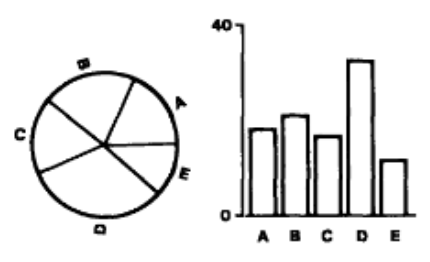
Experiment 2: Position-angle

  • 54 subjects judged pie charts vs. bar charts
  • 10 sets of values, each shown as pie and bar
  • Tasks:
    • Which bar or segment is largest?
    • What percentage each of the other four values is of the largest bar or segment?
Measuring accuracy

They used log absolute error:

\[ \text{Error} = \log_2\left(|\text{judged percent} - \text{true percent}| + \frac{1}{8}\right) \]

Why log scale?

  • Measures relative error (a 5% error on 10% is worse than 5% error on 80%)
  • The \(\frac{1}{8}\) prevents \(\log(0)\) issues
  • Robust to outliers

Experiment results

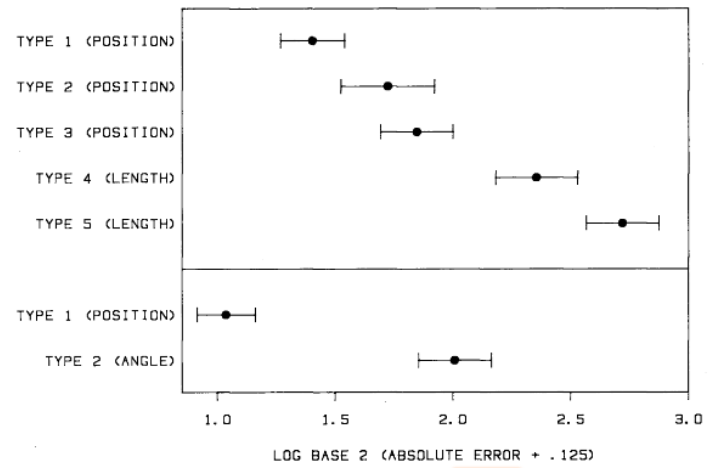
Log absolute error means and 95% confidence intervals for judgment types in position-length experiment (top) andposition-angle experiment (bottom).

Position-length: Average errors for length judgments are considerably larger than those for position judgments.

Position-angle: Average errors for angle judgments is considerably larger than for position judgments.

Activity

Task

For each chart shown, identify the smaller of two marked values (A or B), then estimate what percentage the smaller is of the larger.

  • Make a quick visual judgment
  • Do NOT measure or calculate
  • Record your answer

Activity instructions

  1. You will see 6 charts - 2 of each type:
    • Bar charts (position judgment)
    • Pie charts (angle judgment)
    • Bubble charts (area judgment)
  2. For each chart:
    • Identify which value (A or B) is smaller
    • Estimate: “The smaller is ___% of the larger”
  3. Record answers on the provided sheet

Practice: Bar chart

Which is smaller? What % is it of the larger?

Practice answer

A = 35, B = 70

A is smaller.

True percentage: 35/70 = 50%

How close was your estimate?

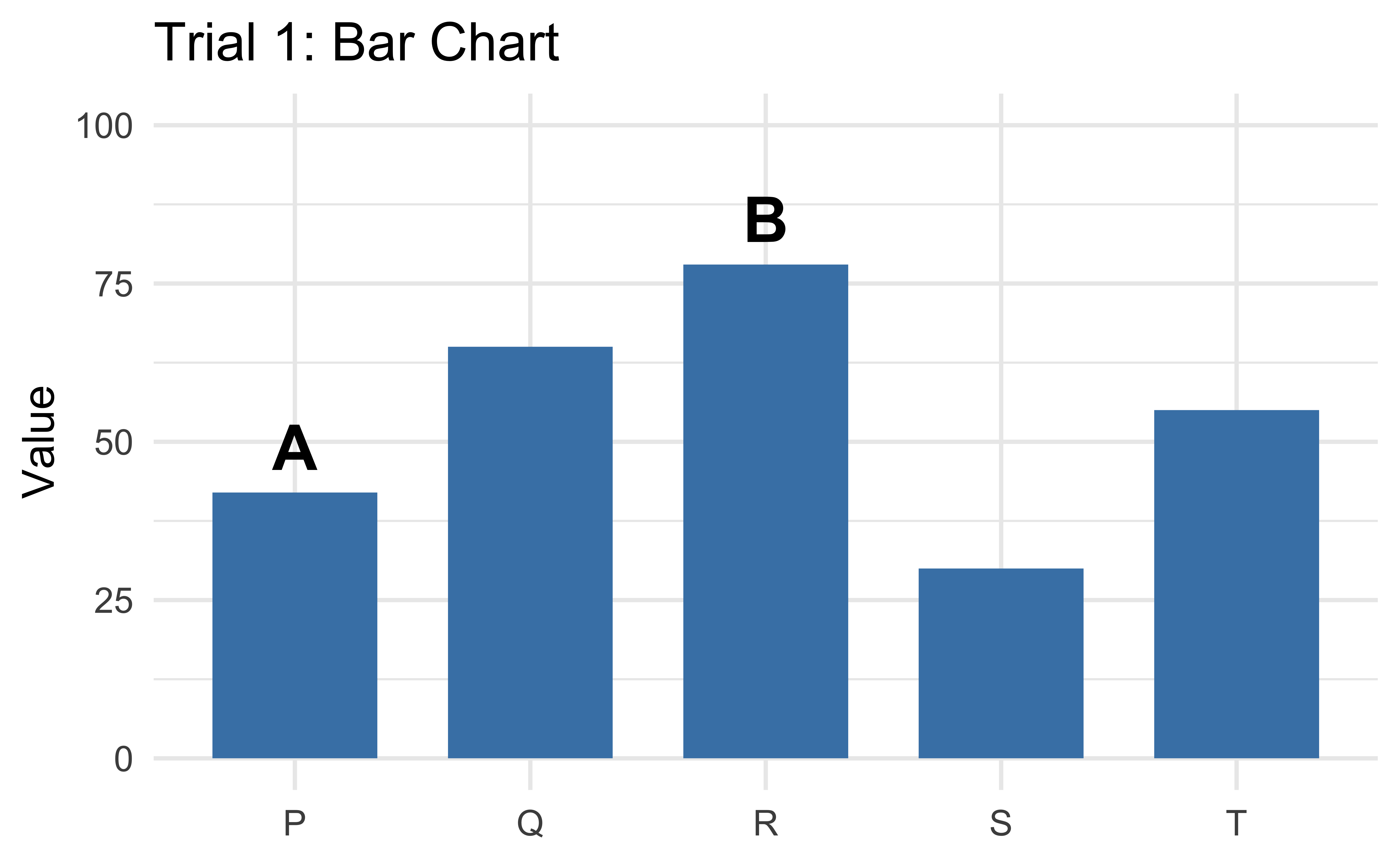
Trial 1: Bar chart

Record: Smaller = ___ | Estimate = ____%

Trial 2: Bar chart

Record: Smaller = ___ | Estimate = ____%

Trial 3: Pie chart

Record: Smaller = ___ | Estimate = ____%

Trial 4: Pie chart

Record: Smaller = ___ | Estimate = ____%

Trial 5: Bubble chart

Record: Smaller = ___ | Estimate = ____%

Trial 6: Bubble chart

Record: Smaller = ___ | Estimate = ____%

Answer key

Trial Chart Type True Values Smaller True %
1 Bar A=42, B=78 A 53.8%
2 Bar A=28, B=85 A 32.9%
3 Pie A=18, B=30 A 60.0%
4 Pie A=12, B=25 A 48.0%
5 Bubble A=35, B=28 B 80.0%
6 Bubble A=65, B=25 B 38.5%

Calculate your error

For each trial, calculate:

\[\text{Error} = |\text{Your estimate} - \text{True percent}|\]

Then, add your results to https://duke.is/sta313-apr13, so we can calculate average by chart type:

  • Bar chart error = (Error 1 + Error 2) / 2
  • Pie chart error = (Error 3 + Error 4) / 2
  • Bubble chart error = (Error 5 + Error 6) / 2

Class results

Let’s collect and visualize our class results.

  • What was your average error for each chart type?
  • Did the class results follow the Cleveland & McGill hierarchy?

Expected pattern:

Bar chart error < Pie chart error < Bubble chart error

(Position < Angle < Area)

Discussion questions

  1. Which chart type gave you the most trouble? Why?

  2. Were there any trials where you felt confident but were actually far off?

  3. How might these findings change how you design visualizations?

  4. When might you still choose a “less accurate” encoding?

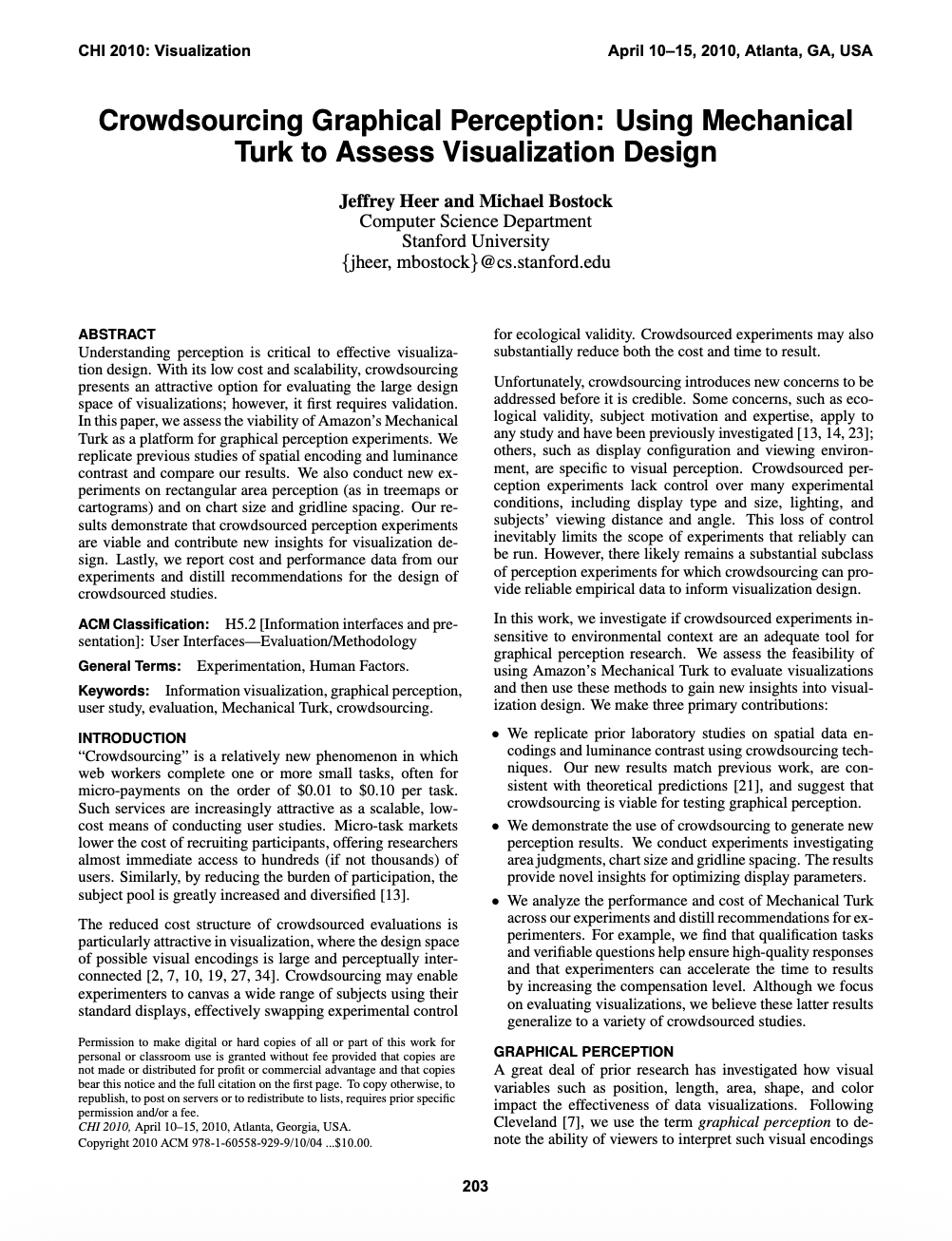
Heer & Bostock (2010)

Crowdsourcing graphical perception

26 years later…

Jeffrey Heer and Michael Bostock (Stanford) replicated Cleveland & McGill using Amazon Mechanical Turk.

Why replicate?

  • Test if crowdsourcing is viable for perception experiments
  • Extend to new chart types (treemaps, bubble charts)
  • Larger, more diverse subject pool

Experiment 1A: Replicating Cleveland & McGill

Method:

  • 7 judgment types (5 from original + 2 new)
  • N=50 subjects per chart
  • Same proportional judgment task
  • 70 total trials (HITs)

New additions:

  • Type 6: Angle (pie chart)
  • Type 7: Circular area (bubble chart)

Replication results

Cleveland & McGill (1984)

  • Lab setting
  • ~50 subjects
  • Paper-based

Results showed clear ranking: T1 < T2 < T3 < T4 < T5

Heer & Bostock (2010)

  • Crowdsourced (MTurk)
  • ~50 subjects per condition
  • Web-based

Same ranking preserved!

Crowdsourcing validated as viable method.

New insights from Heer & Bostock

Experiment 1B: Rectangular area judgments

  • Tested treemaps and rectangle comparisons
  • Found aspect ratio affects accuracy
  • Squares (1:1 ratio) are not optimal
  • Rectangles with extreme ratios performed worst

Experiment 3: Chart size and gridlines

  • Tested chart heights: 40, 80, 160, 320 pixels
  • Tested gridline spacing: 10, 20, 50, 100 units
  • Findings:
    • Charts under 80 pixels have significantly more error
    • Gridlines help, but too dense (10 units) impedes reading

Extended hierarchy

Based on combined evidence, the updated ranking:

Rank Perceptual Task Chart Examples
1 Position (common scale) Bar chart, dot plot
2 Position (non-aligned) Small multiples
3 Length Stacked bar (non-baseline)
4 Angle Pie chart
5 Circular area Bubble chart
6 Rectangular area Treemap

Implications for design

Redesigning common graphs

Cleveland & McGill suggested replacements:

Instead of… Use…
Pie chart Dot chart or bar chart
Divided bar chart Grouped dot chart
Stacked area chart Multiple line charts
Choropleth map Framed rectangle chart

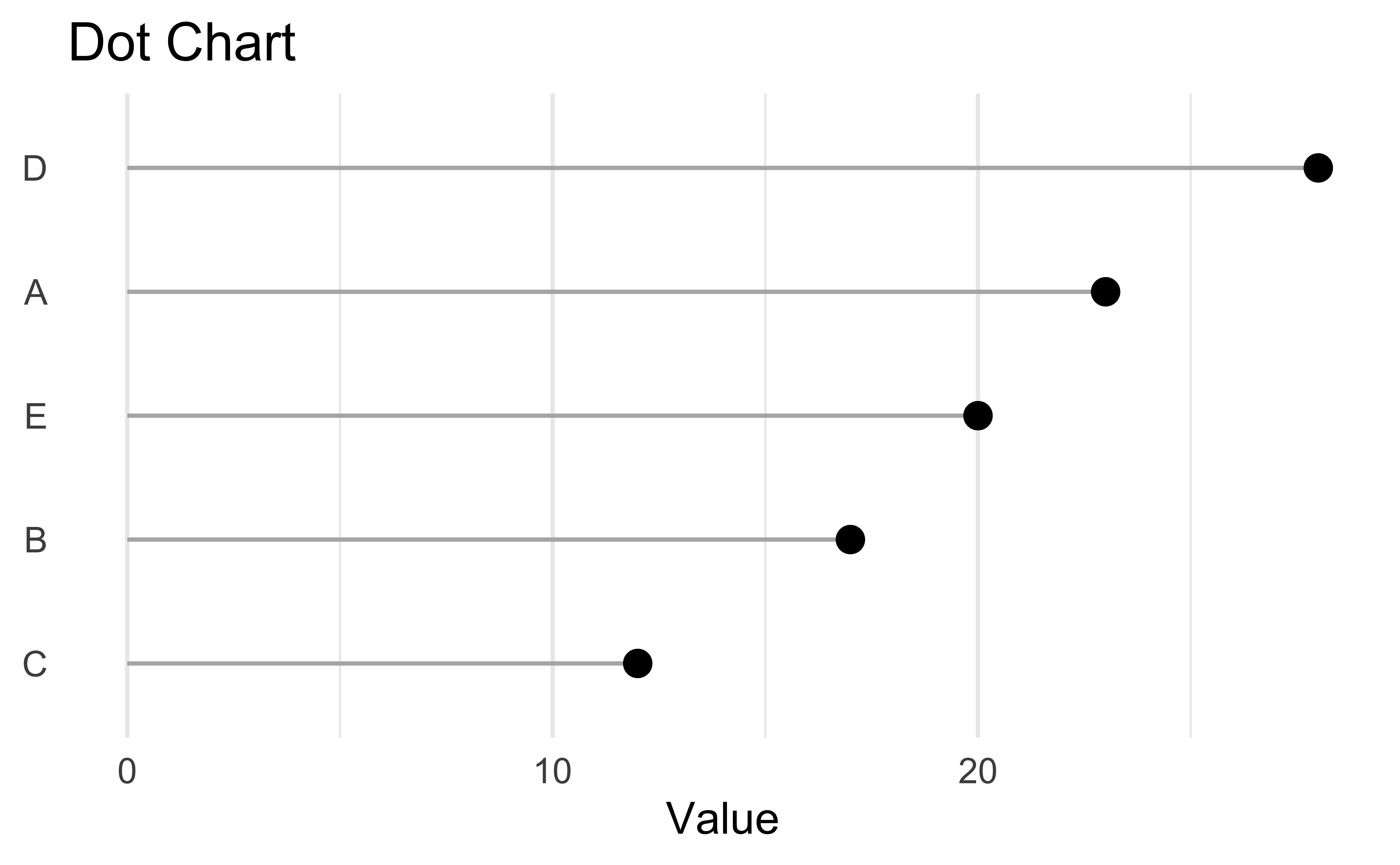
Dot (lollipop) chart: A Cleveland favorite
Limitations to keep in mind

The hierarchy applies to extracting precise quantitative values, but:

  • Part-to-whole relationships: Pie charts can show “roughly half” well
  • Patterns and trends: Position isn’t always the goal
  • Memorability: Some “worse” encodings may be more memorable
  • Engagement: Aesthetic appeal matters for communication

Note

The “best” chart depends on the task and audience. Cleveland & McGill’s hierarchy is a guide, not a rule.

Further reading

Original papers:

  • Cleveland, W. S., & McGill, R. (1984). Graphical perception: Theory, experimentation, and application to the development of graphical methods. Journal of the American Statistical Association, 79(387), 531-554.

  • Heer, J., & Bostock, M. (2010). Crowdsourcing graphical perception: Using Mechanical Turk to assess visualization design. CHI 2010.

Related:

  • Cleveland, W. S. (1993). Visualizing Data. Hobart Press.
  • Munzner, T. (2014). Visualization Analysis and Design. CRC Press, Ch. 5.